The AI Quagmire
Benefits, Risks, and Aspirations Through a Disability Lens
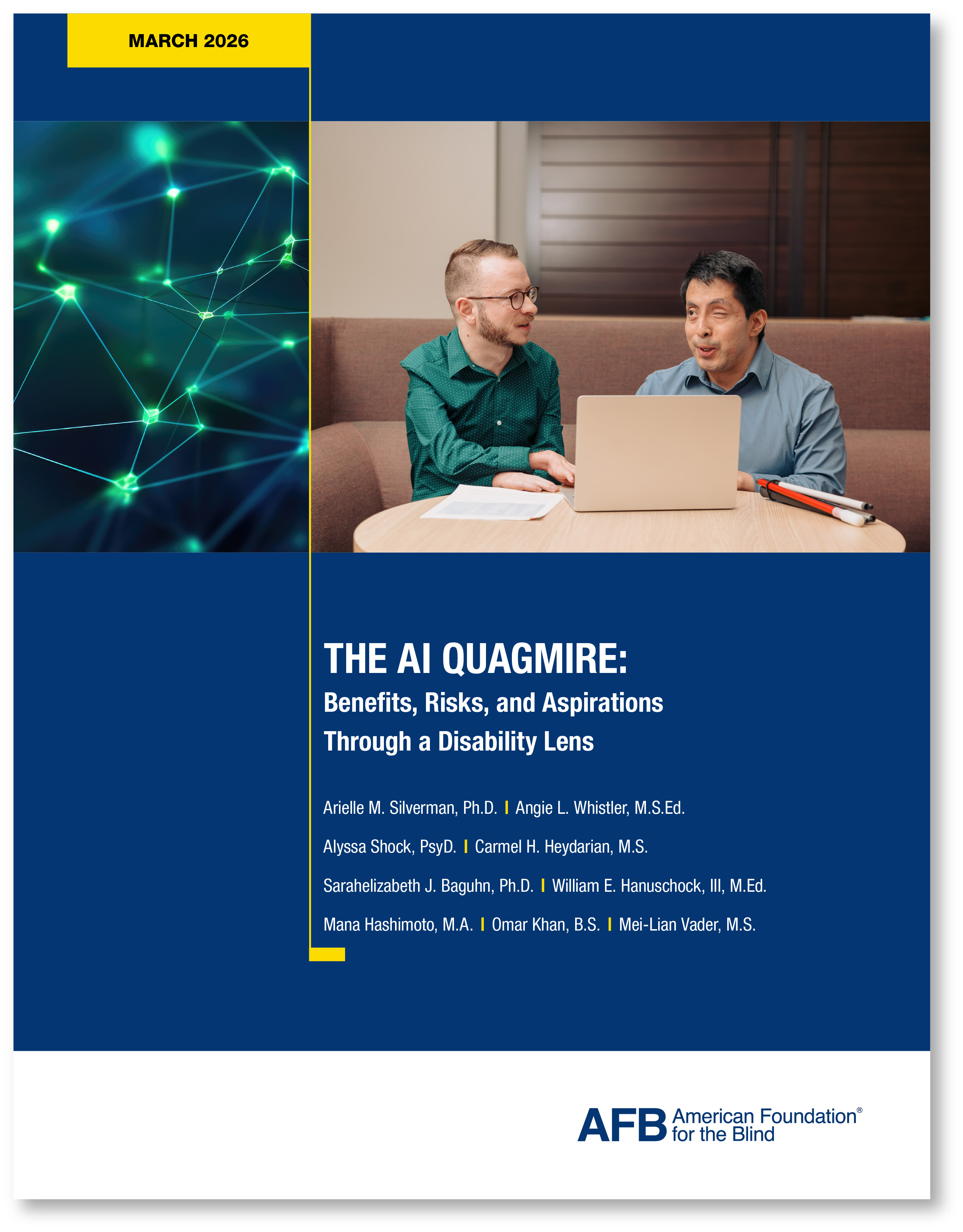
Research Report | March 2026
Artificial intelligence is infiltrating all aspects of our lives shaping how people learn, work, communicate, and access essential services. For people with disabilities, including those who are blind or have low vision, AI promises the moon: enabling access to information across formats, supporting independence, and reducing longstanding barriers. At the same time, the expansion of AI introduces new and often poorly understood risks, including its own inaccessible design features, biased decision-making, privacy concerns, and overreliance on systems that may not yet be accurate or equitable.
The findings from AFB’s national survey of AI users with and without disabilities highlight a central tension: AI is both a powerful accessibility tool and a source of emerging inequities. Participants reported widespread adoption of AI, meaningful benefits in communication and productivity, and strong interest in further skill development. Yet they also described persistent accessibility barriers, challenges in high-stakes contexts such as employment and healthcare, and a clear preference for human interaction when privacy is at stake.
This report, The AI Quagmire: Benefits, Risks, and Aspirations Through a Disability Lens, shares AFB’s analysis of current usage trends, which can be used by developers, employers, educators, policymakers, and users themselves. We invite you to join us in leveraging this data to make intentional design choices, rigorous evaluation of AI tools, and shared accountability to ensure that AI expands access rather than deepens disparities.
Read the Report Online
- Executive Summary
- Introduction
- Description of Participants
- AI Learning Methods
- Select Uses and Benefits of AI
- Harms of AI in Various Contexts
- Privacy Concerns
- Aspirations for Future AI
- Discussion
- Recommendations
- References
Download the Report
Screen Reader Tip: The complete AI Quagmire Report is greater than 50 pages in length, and Acrobat, by default, will only load one page at a time for longer documents. In a longer document, you can use Ctrl + Page Up or Page Down to navigate from page to page.
Download the AI Quagmire Report
Download the Executive Summary
If you have any questions, please get in touch with our Public Policy and Research Institute at research@afb.org.
Access Supplementary Research
AFB is publishing a series of detailed reports that explore the findings from the AI Quagmire. Each report focuses on a different topic and shares data to help us understand how AI intersects with the lives of people with disabilities. Read the first three available reports:
- Transportation — Navigating Toward AI: Transportation Access in a Changing Technology Landscape
- Employment — Working with the Machine: AI’s Expanding Role in Employment for People With Disabilities
- Assistive Technology — Innovation for Access: AI and Its Use as Assistive Technology for People with Disabilities
AFB Webinar
On March 25, 2026, AFB hosted an exclusive webinar unveiling the results from this report, The AI Quagmire. We were joined by guest speaker Maitreya Shah, Technology Director at the American Association of People with Disabilities, who helped place our findings in the broader conversation about building inclusive AI policies and practices.
Learn More & Access the WebinarPublication Details
Authors:
Arielle M. Silverman, Ph.D. | Angie L. Whistler, M.S.Ed. | Alyssa Shock, PsyD. | Carmel H. Heydarian, M.S. | Sarahelizabeth J. Baguhn, Ph.D. | William E. Hanuschock, III, M.Ed. | Mana Hashimoto, M.A. | Omar Khan, B.S. | Mei-Lian Vader, M.S.
Language Note:
In this report, we have used both person-first language (“people with disabilities”) and identity-first language (“disabled people”) when describing disability. This is an intentional choice meant to honor differing preferences within the broader disability community, an approach supported in research literature (e.g., Dunn & Andrews, 2015). In addition, we have used identity-first terms when specifically describing three disabilities: “BLV people” meaning blind and low-vision people; “D/HH people” meaning deaf/Deaf and hard-of-hearing people; and “autistic people.” This choice reflects the strong preference for identity-first language voiced by many members of these particular communities.
Acknowledgements:
We thank Sarah Malaier and Stephanie Enyart for developing the recommendations at the end of this report and for offering feedback on earlier drafts. We are also grateful to the working group of 19 disability organizations whose input shaped the survey questions and design.
Suggested Citation:
Silverman, A. M., Whistler, A. L., Shock, A., Heydarian, C. H., Baguhn, S. J., Hanuschock, W. E., Hashimoto, A., Khan, O., & Vader, M-L. (2026). The AI Quagmire: Benefits, Risks, and User Aspirations Through a Disability Lens. American Foundation for the Blind.
Image Credit:
Disability-inclusive stock photography courtesy of Disability:IN. Photographs by Jordan Nicholson. Used under the Creative Commons Attribution–NoDerivatives 4.0 International License.
Funding Acknowledgment:
We thank the Ford Foundation for supporting American Foundation for the Blind’s efforts on AI and workplace technology to ensure equal rights for people with disabilities.