Fact Sheet: Aging
Updated May 2026
Many Older Adults Experience Blindness or Low-vision
There are about 13.6 million people ages 65 and older in the United States who have difficulty seeing even with glasses or contact lenses, and 1.6 million of those people are blind or cannot see.1 This represents 22.8% of U.S. residents aged 65 and older. American Foundation for the Blind (AFB) researchers have studied challenges older adults may face when they lose vision and changes we can make to reduce these challenges.
Location Affects Transportation Access, Leading to Isolation
Older adults living in rural areas may have trouble finding eye doctors, support groups, or people who can teach them skills for living with vision loss. They may also have trouble getting around without driving.
Blind and low-vision older adults who live in rural areas typically face more barriers than those in urban areas due to the greater reliance on personal vehicles for transportation. Barriers include not living near a bus or train stop, needing to schedule transportation in advance, not having enough paratransit services, and rideshare (Uber or Lyft) drivers not helping them find a destination. These barriers often result in blind and low-vision rural inhabitants not leaving their homes as often.2 It is worth noting that even in urban areas, older adults who are blind face greater transportation issues as they become nondrivers or experience other disabilities that may affect walking or navigating.
In one study, AFB researchers asked where older adults would go if they had the transportation to go wherever they wanted whenever they wanted. Several respondents said they wanted to explore nature: the beach, the mountains, or hiking where public transportation does not go. Others simply wanted to go places on their own schedule, without needing to plan ahead or wait for a driver.
Earnings Near Retirement are Lower
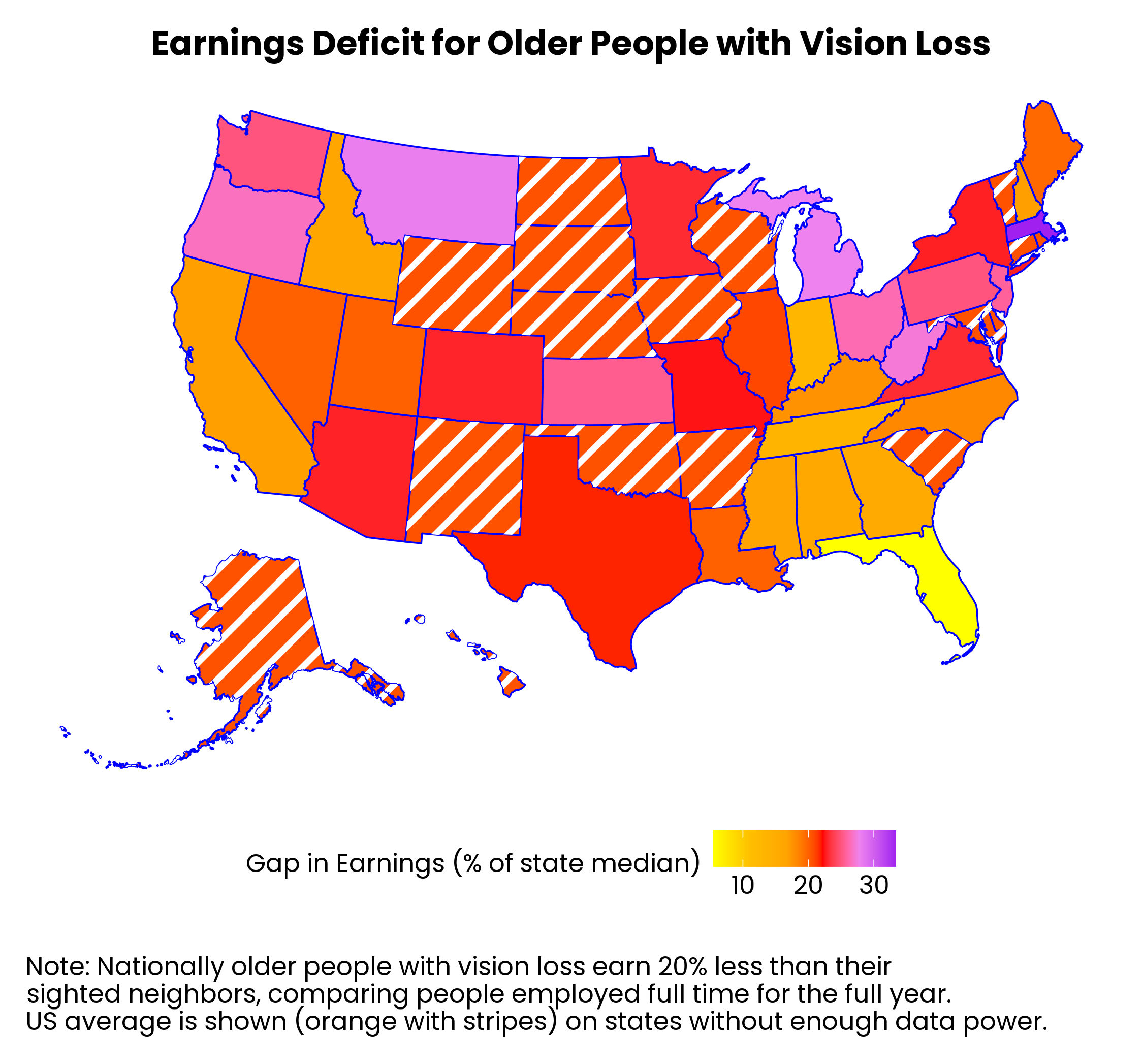
People who are blind or have low-vision earn significantly less in their later years than those without vision difficulty. Nationwide, people with vision difficulty who are 55 and older and who work full-time for the full year make about $12,000 less than people without vision difficulty.3
The earnings gap varies significantly across states. The map below visualizes how the earnings gap varies by state by showing the earnings gap between people with and without vision difficulty as a percentage of median income. The earning gaps range from 33% of median income in Massachusetts to 6% of median income in Florida.
The Rate of Blindness Varies by Geography
Overall, vision difficulty is more common among older adults living in rural areas than those in metropolitan (urban) areas.
The largest difference in vision loss rates by population density occurs in New Mexico. 5.4% of urban residents in New Mexico report experiencing vision difficulty compared to 10.7% of rural residents. Following New Mexico’s 5% difference, Arizona, Alabama, and Kentucky are next with the metropolitan to non-metropolitan percentage gap in vision disability ranging from 2 to 3.6%.4
Some states swing the other direction with more vision difficulty in metropolitan areas. These states include New York, Delaware, and Connecticut.
Disparities in Technology Access Affect Quality of Life
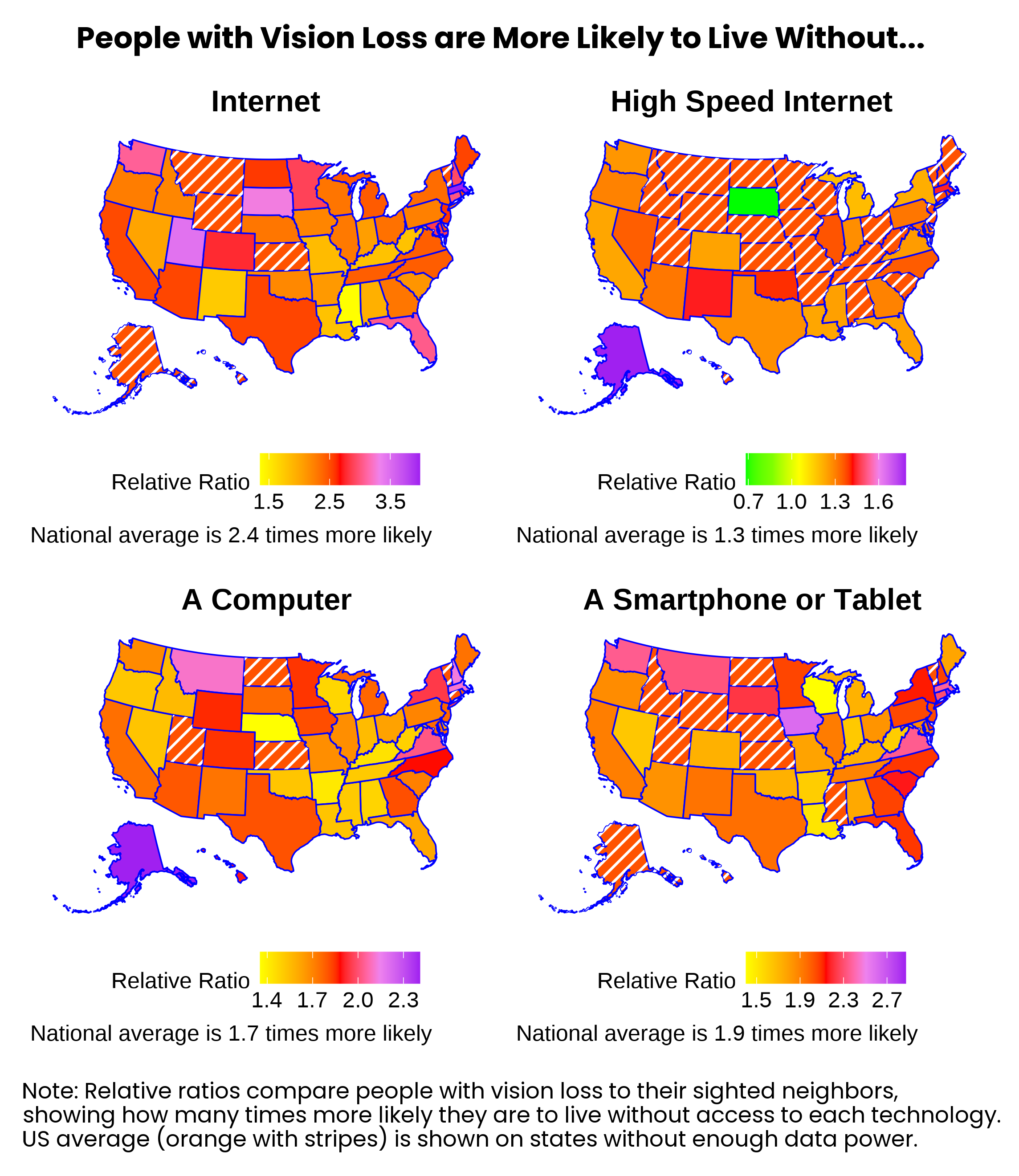
Living in a home without key technology contributes to isolation and other day-to-day barriers for older adults with declining vision. More older adults with difficulty seeing live without important technologies than their fully sighted peers.5
- Nearly 1 in 5 older adults with vision disabilities live without internet access at home, compared with fewer than 1 in 10 sighted older adults.
- Among those who have internet access, 1 in 4 older adults with vision disabilities live without high-speed internet access, compared to 1 in 5 without vision disabilities.
- More than 1 in 3 older adults with vision disabilities live without a computer, compared with 1 in 5 without vision disabilities.
- About 1 in 7 older adults with vision disabilities live without a smartphone or tablet, compared with 1 in 14 without vision disabilities.
The following maps illustrate the range and severity of technology access barriers in US states for older adults with vision difficulty. Relative ratios larger than 1 mean people with vision loss are more likely to not have the technology than their sighted peers.
Digital exclusion is not only about technology. Because technology is now a key part of healthcare, communication, services, and daily tasks, these gaps can make it harder for older adults to attend telehealth visits, access remote rehabilitation, manage finances, complete forms, and stay connected to family, services, and community. Reducing isolation requires making broadband, devices, and accessible digital support more available and affordable for older adults with vision loss.
Mental Health and Happiness: How are Blind and Low-vision Older Adults Doing?
Mental health difficulties can affect how people function in daily life and their overall happiness. Using data from the National Health Interview Survey, AFB researchers compared indicators of mental health between blind and low-vision older adults and those who are sighted.6
Blind and low-vision adults aged 55 and older generally had worse mental health than sighted peers. As people age, mental health difficulties become less common for both groups, but the disparity remains.
Signs of Mental Health Difficulties
- 18% of blind and low-vision older adults compared to 8% of sighted older adults report feeling hopeless at least a little bit of the time. Hopelessness is often linked with depression.
- 47% of blind and low-vision older adults compared to 30% of sighted older adults feel nervous at least a little bit of the time.
- Serious psychological distress is a more severe mental health difficulty, reported by 5% of blind and low-vision older adults versus 1% of sighted older adults.
Support and Connection
- Being socially connected often improves mental health, yet 25% of blind and low-vision older adults compared to 9% of sighted older adults experience at least some difficulty participating in social activities such as going to meetings, going to parties, or visiting friends due to a health condition or disability.
- Emotional support means having one or more people in your life who are “there for” you to offer emotional, social, or psychological help or support in the way you need. Blind and low-vision older adults reported usually or frequently having access to the social and emotional support they need less often than sighted peers, with 71% reporting receiving needed emotional support compared to 79% of sighted people.
Life Satisfaction
Life satisfaction means being happy with life overall. 90% of blind and low-vision older adults report high satisfaction with their lives compared with 97% of sighted people.
Older adults who do not experience vision difficulty tend to be satisfied with their lives more often than those with any degree of vision difficulty. However, people who are completely blind are more satisfied than people with any other level of vision problems, especially for people between 55 and 64 years old. One part of the reason for this could be because in that age range people would have the most access to help adjusting to vision loss and learning non-visual blindness strategies since they are still considered for employment focused services.
Ideally, mental health difficulties should be minimal for both blind and low-vision and sighted older adults. As of now however, there’s a concerning trend that mental health is worse overall for blind and low-vision older adults, showing they are getting less support and resources to help them thrive than sighted peers.
Learn More About Aging with Vision Loss
- AFB Statistics About Older People With Vision Loss
- State Level Data on Aging With Vision Loss
- AFB's Project VISITOR Study
- AFB's Best Practice Guide for Hospitals
- VisionAware
- Making Life More Livable: Simple Adaptations for Living at Home With Vision Loss
References
1 Estimates of older people with vision loss from the National Health Interview Survey (NHIS). The American Foundation for the Blind. (2026). afb.org/research-and-initiatives/statistics/older-vision-loss/estimates-nhis
2 Fact sheet: transportation. The American Foundation for the Blind. (n.d.). afb.org/research-and-initiatives/research/fact-sheets/transportation
6 Mobility and mental health of older people with Vision Loss. The American Foundation for the Blind. (2026). afb.org/research-and-initiatives/statistics/older-vision-loss/mobility-and-mental-health